

Wisconsin Clearwaters Trout Unlimited
Past Projects
Dunn County Watershed
Hay Creek
Hay Creek Trout Trends: 1975-2010. No brown trout have been collected in Hay Creek excluding a single fish that was captured in 2009 100ft upstream of 850th st.
Brook trout recruitment trends at 4 trend sites. Site 1 is located upstream of 250th st. Site 2 is located downstream of 190th st. Site 3 is located upstream of 672nd ave. Site 4 is located near the culvert off of Park Rd on school forest property (160th st).
Brook trout adult trends at 4 trend sites. Site 1 is located upstream of 250thst. Site 2 is located downstream of 190th st. Site 3 is located upstream of 672nd ave. Site 4 is located near the culvert off of Park Rd on school forest property (160th st).
Wilson Creek Fact Sheet
Acres: 33,298 (HUC 12- WI – 070500071003) Conservation Easements: 7 (1 restored)
Largest Land uses: Deciduous Forests, Cultivated Crops, Hay/Pasture, Developed/Open
Counties: Dunn and St. Croix Villages: Knapp Cities: Menomonie
Townships: Lucas, Menomonie, Sherman, Stanton (Dunn) and Cady, Springfield (St. Croix)
Geology: Prairie Du Chein Group (top) to Eau Claire Formation (bottom)
Stream Condition: Class 1 in both upper stretches then Class 2 until I-94
Impairment Status: 303(d) listed by Total Phosphorus in the main branch up to the county line
Manure Structures: 12
Freshwater Springs: 37 documented
Trout: Brook & Brown
Stream Monitoring: WDNR Trout Surveys, HBI & IBI Scores, Habitat & Red Cedar Basin Monitoring Group Water Action Volunteer Level 1 and 2
Water Quality Threats: Frequent flooding, unstable banks, and severe bank, gully and upland erosion, all resulting in stream channel entrenchment and the deposit of fine sediment in the stream channel. Sedimentation of the stream channel impairs fish spawning habitat, reduces overall depth required for adult fish habitat and elevates stream temperature. Other causes include nutrient runoff from row crop agriculture, watershed degradation, intensive agriculture and lack of sound land management practices on the landscape.
Hay Creek
Chippewa County

Wisconsin ClearWaters Trout Unlimited and DNR plan Hay Creek Project
Hay Creek is a Class I trout stream that meanders for six miles through western Chippewa County before it empties into Duncan Creek. It is home to a native brook trout population that is sustained entirely by natural reproduction. The density is well above the average for western WI with about 2,500 brook trout per mile. However, due to a lack of habitat, there is about 1,200 brook trout per mile in the proposed project site downstream of 93rd Street.
The proposed site for the habitat improvement project has the potential to have a brook trout density equal to or above that of the rest of the stream. This habitat project will add to the long history of trout habitat work that was completed in Hay Creek the 1960s and 1970s. Much of the habitat work is accessible to the public, including the proposed site, because easements provide angler access along almost the entirety of the stream.
Hay Creek has excellent water quality and has been designated a brook trout reserve stream by the Wisconsin DNR.
Brook trout reserve streams are streams where brook trout will likely persist into the future given the current climatic projections. Reserve streams have healthy brook trout populations, strong groundwater input (modeled), and low catches of non-native salmonids. Reserve streams are given priority when it comes to easement acquisition, trout habitat improvement projects and native plantings that will provide future shading.
Additionally, Hay Creek is an important coldwater tributary for the thermally challenged Duncan Creek, due to an upstream impoundment. Hay Creek likely provides thermal refuge for trout from Duncan Creek during warm stretches in the summer, and it also is a seed source for brook trout recruitment into Duncan Creek.
Sand Creek Project

The Wisconsin ClearWaters of Trout Unlimited (WCWTU) and the Wisconsin Department of Natural Resources (WDNR) announce work has begun on a newly acquired Sand Creek easement. The new easement is between two previous stream restoration projects, and once completed will create substantial stream habitat for trout, land and water species that thrive on cold and clean water. The Wisconsin DNR project manager Nate Anderson stated that the new easement target date for the competition is July 2018.
In the past Sand Creek has undergone multi-year easement rehabilitation projects. Funding and contributions have come from WCWTU, WDNR, Xcel Energy, Dunn County Fish and Game and the Chippewa Valley Outdoor Resource Alliance.
Because of these rehabilitation projects, Sand Creek enhances its ability to provide clean water as a feeder stream to the Red Cedar River.
Last winter this large pile of rock was delivered in preparation for the DNR crew to work there magic on the new easement. The plan is to update this page as the rock moves from the pile to the stream, but do not wait for us to update the page. You are more than welcome to view the work in progress, and bring your waders and fly rod check the past work. Trust us you will be amazed.
There are special regulations for Sand Creek and there are DNR crews working in the area! You have been warned.

Buffalo County Streams
In 2009, the Alma Rod and Gun Club asked NRCS for assistance with habitat work on Trout Creek. With cooperation from a concerned landowner, the completed the project in 2012. The first of many completed projects in Buffalo County. Since that time, the Waumandee Rod and Gun Club, Fountain City Rod and Gun Club, and Arcadia Sportsmans Club have completed projects with 13 landowners on 9 miles of cold water streams. All of these streams are capable of supporting native reproducing brook trout. With easements that were donated by the landowners, more funds were able to be used for habitat work. We were also fortunate to have an attorney that was willing to do the legal work for these easements free of charge.
Sources of funding used on sites have been:
Starting in 2009, the goal of the project of agencies, clubs and organizations were to have this work completed at no cost to the landowner. To date, with cooperation from all partners, this has been accomplished.
Sources of funding used on these sites have been: USDA-Natural Resources Conservation Service, WDNR (Trout Stamp and Conservation Aids), local conservation clubs, Trout Unlimited, US-Fish and Wildlife Service, Buffalo County, and some private donations.
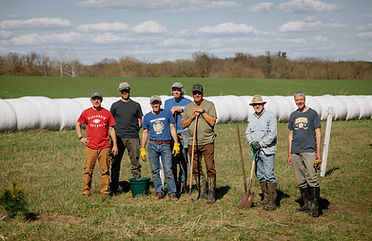
Local FFA Chapters, 4-H Clubs and Boy Scouts have provided labor for some of these projects also.
Trout Unlimited has been instrumental in guiding clubs and local conservation personnel as to what sources are available and how to apply or request these funds. What everyone has learned is that by partnering, many tasks can be accomplished. Not to mention, improved cold water fisheries and more fishing opportunities.
Many of these sites also include habitat work for other aquatic species.
Many of these sites also include habitat work for other aquatic species, such as snake hibernaculum and turtle hibernaculum.
Upon completion of these projects, there has been a renewed interest in trout fishing in Buffalo County. We have also worked together to have a Trout Day for four consecutive years at a different location each year. The purpose is to encourage children to participate in fishing and showcase the projects that everyone has produced. All participants get a free lunch, and all kids go home with a prize. Along with fly fishing demonstrations, fly tying, electrofishing, and discussion of future projects, this event has been a success averaging about 75 participants each year.
Buffalo County Land Conservation Department has initiated and sustained a stream monitoring program
Along with habitat work, Buffalo County Land Conservation Department has initiated and sustained a stream monitoring program in Buffalo County. Volunteers in the community accomplish this and provide data that is recorded to monitor water quality on a given stream. Currently, Buffalo County is soliciting more volunteers to gather more data on some currently unmonitored streams.
In August 2016, a major rainstorm engulfed a large part of Buffalo County that produced 8 to 11 inches of rain in an overnight event. Many discussions in the county were about how the “trout stream work held up to the storm.” These sites were slightly affected, if any, by this major rainstorm and this has created further interest in “getting one of those projects on my farm.”
In summary, Buffalo County has many partners making these projects a success. Trout Unlimited involvement has played a significant role on the road to successful Buffalo County Stream Habitat project.
Trout Transfers
A TU/DNR partnership improving coldwater fisheries
The Clear Waters Chapter of Trout Unlimited helped make trout fishing better in the greater Eau Claire area by funding trout transfer projects on local trout streams. Since 2013, the Clear Waters Chapter has provided annual funding to complete transfer projects on Elk Creek and Duncan Creek. In certain reaches, trout densities were high (3,000-6,000 fish/mile) and size structure was poor. With the goal of improving trout size structure, trout were transferred from areas of high density to locations further downstream in the watershed where natural reproduction is limited and densities are low. In both creeks only moderate size fish were transferred, leaving the young-of-year fish to repopulate the stream and the adult fish to grow to a larger size. Each year between 500 and 1,000 fish was transferred in each stream. Has the project been successful? At the removal sites, the density of brook trout over 12” increased in Duncan Creek and density of brown trout over 14” increased in Elk Creek. At the transfer locations further downstream, densities are increasing as well creating better fisheries than before. All in all, the funding that the Clear Waters Chapter provided has enabled the DNR to conduct a unique project that has produced bigger trout in our local waters.